What is Speaker Cone Excursion (Xmax)?
Pushing a subwoofer too hard can result in a catastrophic mechanical failure. Understanding cone excursion-and your speaker's physical limits-is the key to designing an enclosure that plays loud and survives the test of time.
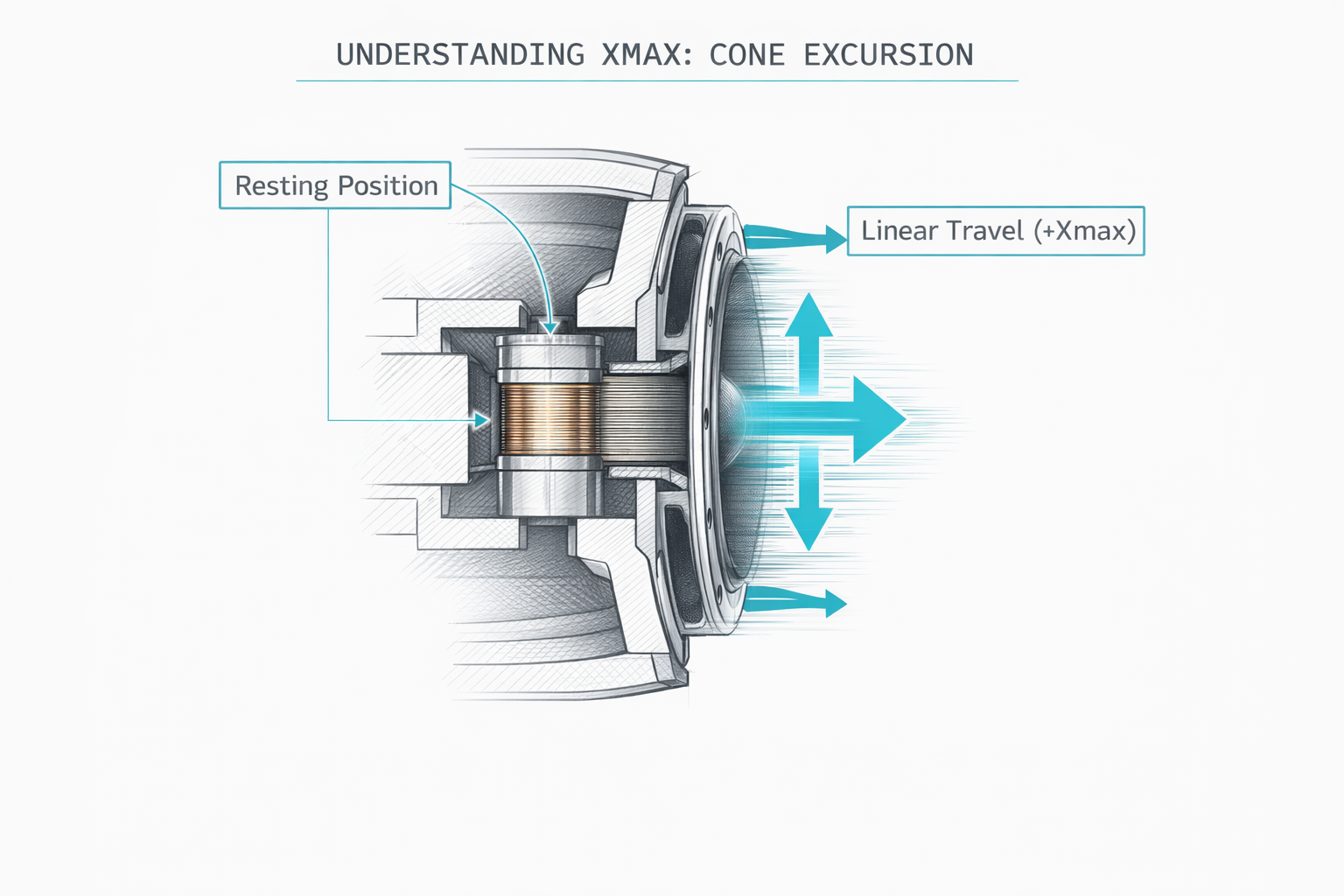
The Basics of Cone Movement
In simple terms, excursion is the back-and-forth movement of a speaker cone. To produce sound, especially low-frequency bass, the subwoofer needs to move air. The deeper the bass and the louder the volume, the further the speaker cone has to travel from its resting position.
Xmax vs. Xmech: Knowing the Limits
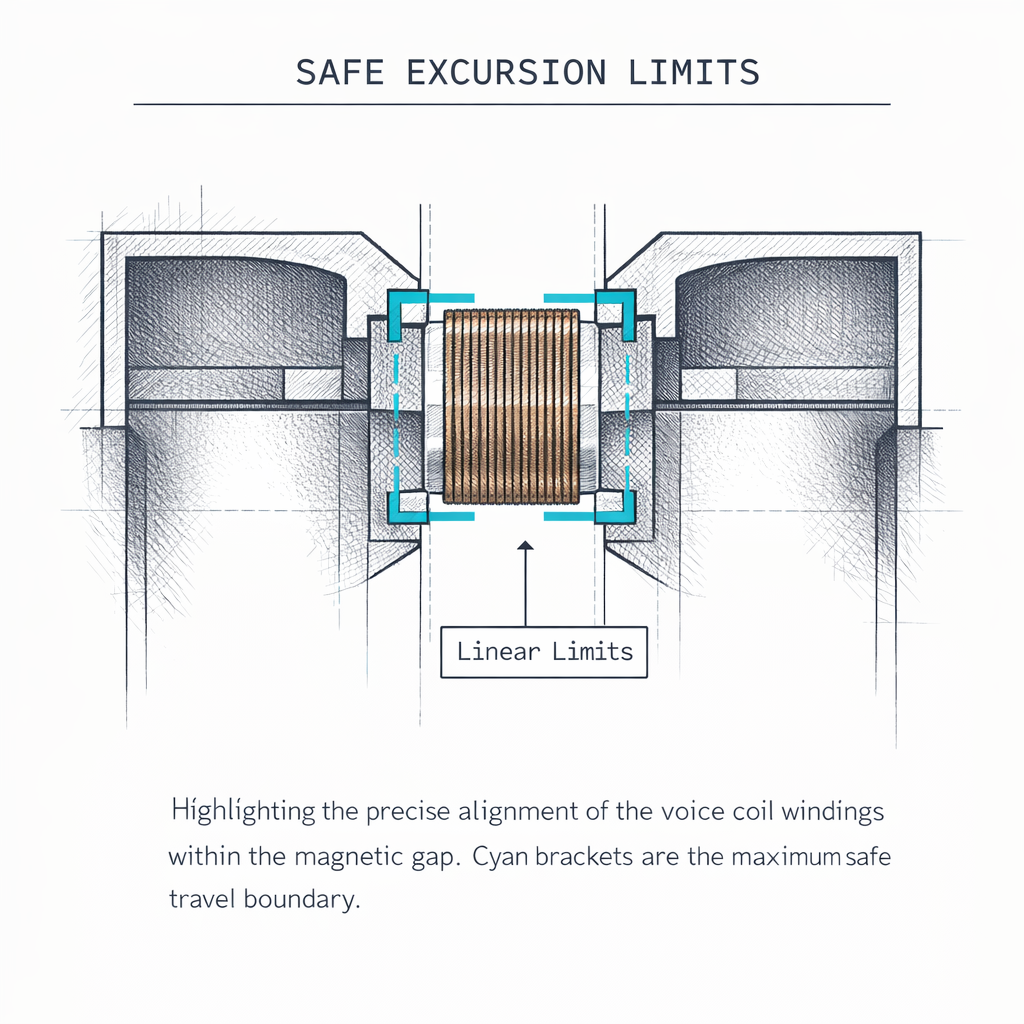
When you look at a speaker's spec sheet in our T/S parameters database, you will likely see two different measurements for excursion:
Linear Excursion (Xmax)
Xmax is the maximum distance the speaker cone can travel in one direction while keeping the voice coil inside the magnetic gap. As long as the speaker stays within its Xmax limit, the audio signal remains clean, controlled, and distortion-free. This is your safe operating zone.
Mechanical Damage Limit (Xmech or Xlim)
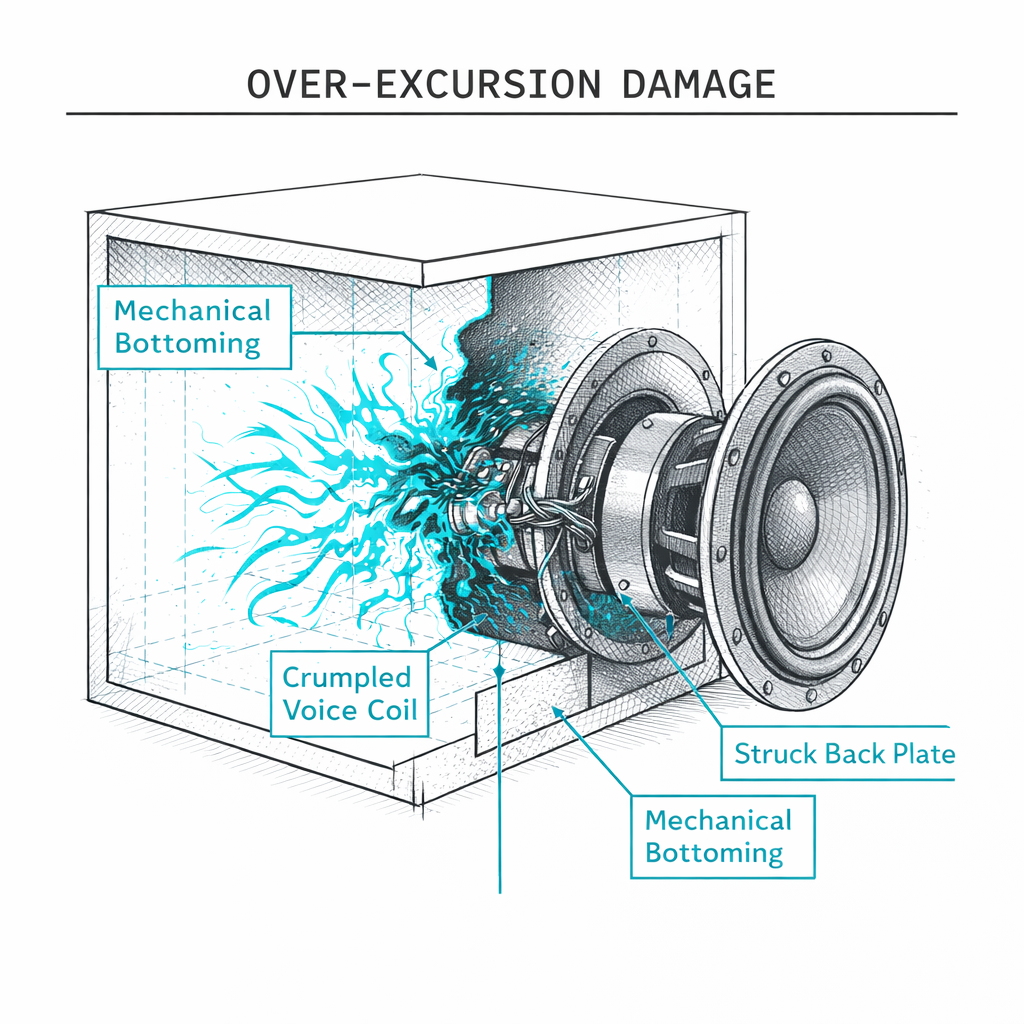
Xmech is the absolute physical limit of the speaker's suspension. If the cone travels this far, physical damage will occur. The voice coil might smash into the backplate, or the spider (the rippled fabric ring keeping the coil centered) could rip. You never want to reach Xmech.
Why Enclosure Design Affects Excursion
The box you build plays a massive role in controlling how far your speaker cone moves.
In a sealed box, the trapped air acts as a spring. As you play deeper frequencies, the air pressure naturally pushes back against the cone, helping to prevent it from exceeding its Xmax.
In a ported (vented) box, the behavior is very different. Above and around the tuning frequency (Fb), the port does most of the work, and cone movement is actually very small. However, when you play frequencies below the box's tuning frequency, the port suddenly acts like an open window. The speaker loses all acoustic suspension and will wildly flap out of control (unloading), easily destroying the subwoofer if you don't use a subsonic filter.
Protect Your Investment
Don't wait until you hear a cracking noise to find out your box is wrong. Input your system power and speaker specs into our online subwoofer box simulator. Our software maps the exact cone excursion across all frequencies so you can visually guarantee your driver stays safely within its Xmax.
Model Cone Excursion