Understanding Subwoofer Box Losses (Ql, Qa, Qp)
In a perfect mathematical world, speaker enclosures have no leaks, walls don't flex, and air moves without friction. In the real world, "box losses" happen. Here is how they impact your audio build.
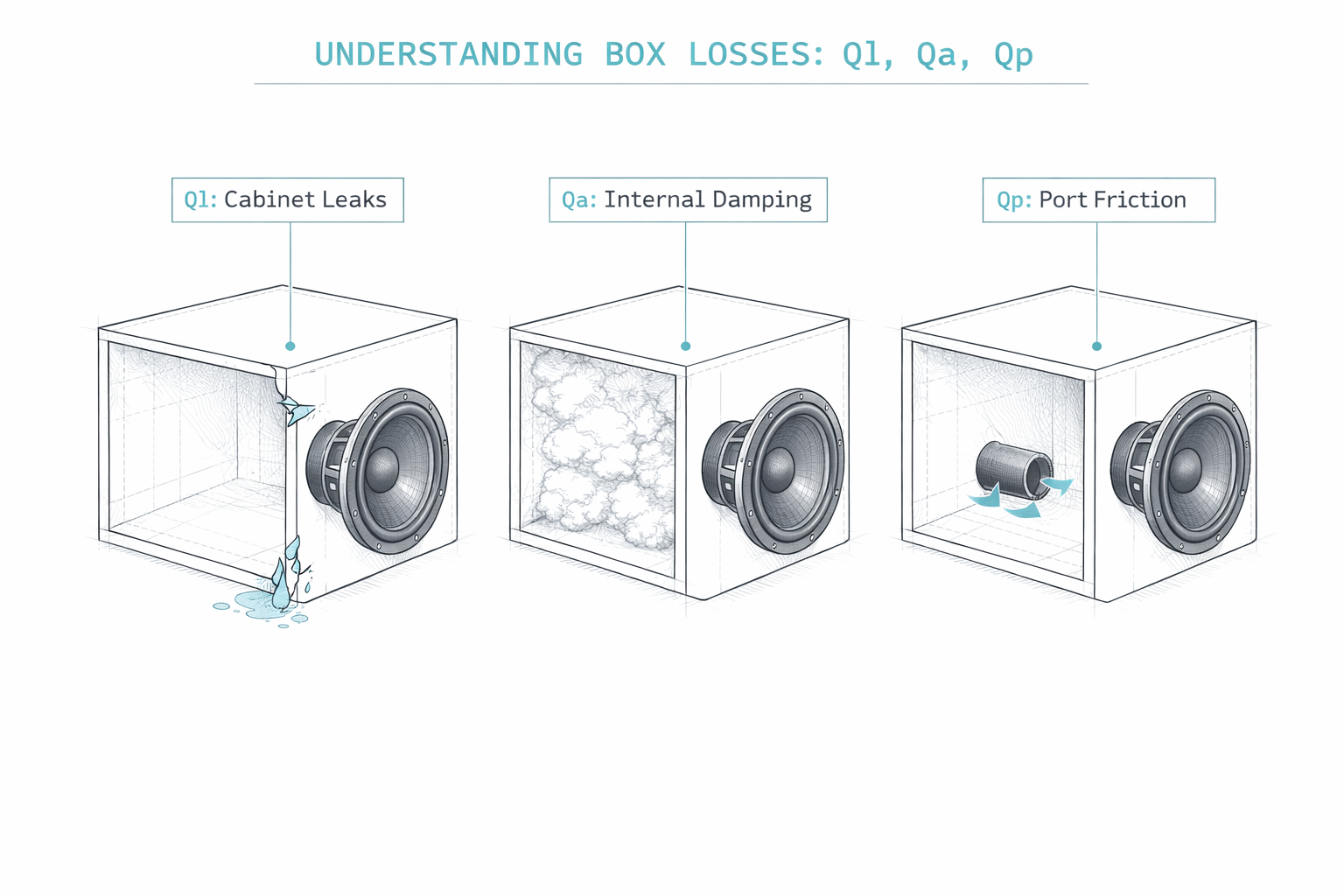
Why Real-World Enclosures Aren't Perfect
Basic online calculators assume an ideal scenario. However, professional designers know that constructing a physical box introduces minor inefficiencies. By accounting for these variables-known as Q-factors of the box-you can dramatically improve the accuracy of your frequency response graphs before you even cut your first piece of wood.
The Three Types of Box Losses
There are three main types of acoustic losses you need to account for when designing a subwoofer enclosure:
1. Ql (Leakage Losses)
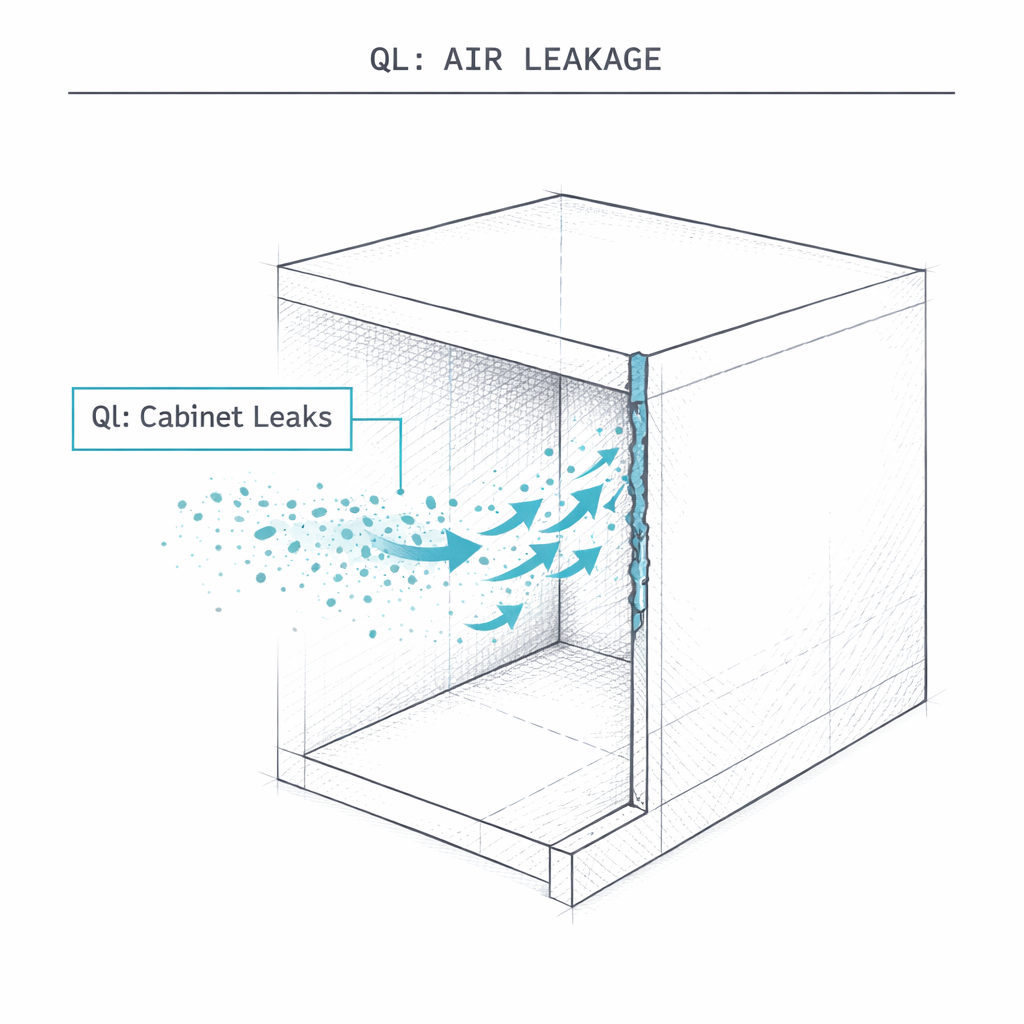
Ql accounts for the tiny air leaks in your cabinet. Even if you use wood glue and silicone, air can still escape through the subwoofer mounting holes, the speaker terminal cup, or tiny imperfections in the joints.
A completely airtight box would have an infinite Ql. In practice, a standard, well-built enclosure has a Ql of around 7. If your box is poorly sealed, this number drops, which can slightly reduce bass output and alter the tuning.
2. Qa (Absorption Losses)
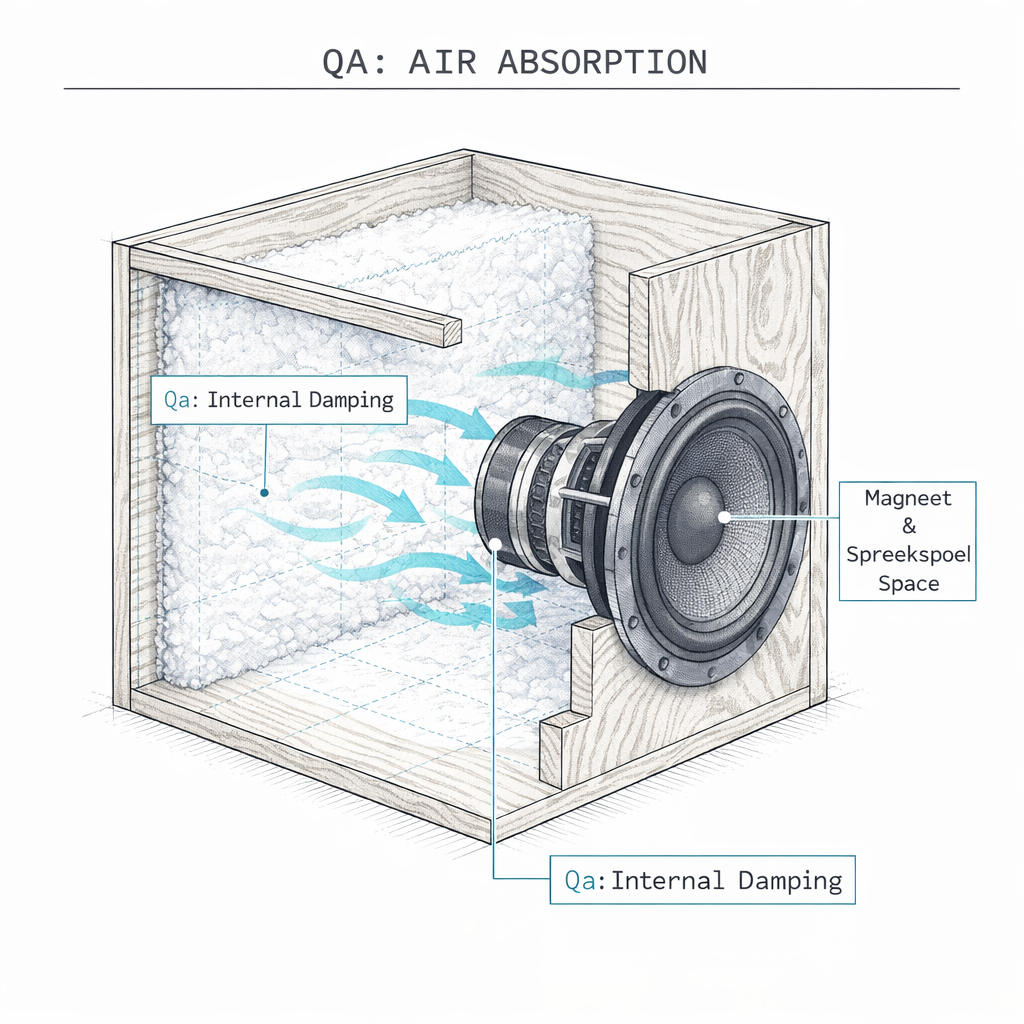
Qa measures the acoustic energy absorbed by the internal walls of the box and any stuffing you put inside (like polyfill or fiberglass).
An empty wooden box with bare walls typically has a Qa of 100 (minimal absorption). If you heavily stuff the box with acoustic damping material, the Qa drops significantly (often to 30 or lower). Adding stuffing tricks the subwoofer into behaving as if the box is physically larger, altering the frequency response curve.
3. Qp (Port Friction Losses)
Qp applies only to vented (ported) enclosures. It accounts for the friction of the air moving back and forth through the port.
A smooth, flared PVC pipe will have very low friction (a high Qp of 100 to 120). A narrow, rough wooden slot port with sharp 90-degree corners will have higher friction (a lower Qp), slightly reducing the port's efficiency and peak output.
Applying Box Losses to Your Design
If you want professional-grade results, you should always model these losses. Before you jump into a speaker box calculator to get your wood dimensions, you need to see how these real-world physics will alter your sound.
Model Your Real-World Box
Ditch the old desktop software. Our free online subwoofer box simulator includes an advanced box losses panel. You can manually tweak Ql, Qa, and Qp to see exactly how leaks, polyfill, and port friction will impact your final frequency response.
Start Advanced Simulation